

























China Travel & Cultural Tourism Data and Emerging Trends
China’s tourism market in 2025 demonstrates clear structural recovery, with synchronized growth in travel volume and consumer spending. The latest China domestic travel data indicates that the market has entered a phase of quality-driven expansion, supported by diversified traveler segments and resilient consumption momentum.
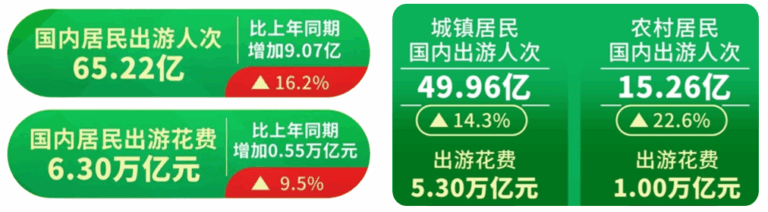
(Data source: Xinhua News)
Key Highlights:
- 522 billion domestic trips, up 16.2% YoY
- RMB 6.30 trillion in domestic tourism expenditure, up 5% YoY
- Urban residents:996 billion trips (+14.3%), RMB 5.30 trillion in spending
- Rural residents:526 billion trips (+22.6%), RMB 1.00 trillion in spending
- Accelerated growth from lower-tier and rural markets, strengthening demand diversification
The data signals a transition from rebound-driven growth to structurally diversified expansion within the China tourism market 2025 landscape.
1.0 Inbound Tourism Recovery Accelerates in 2025
China’s inbound tourism market is rebounding strongly in 2025. From January to August, inbound foreign arrivals reached 51.27 million, marking a 27.8% year-on-year increase. The recovery of international passenger traffic is revitalizing major gateway cities and creating renewed growth momentum across the hospitality and tourism sectors.
Policy Driver: 240-Hour Visa-Free Transit
The expansion of China’s 240-hour visa-free transit policy has become a key catalyst for inbound travel growth. Visa-free entries increased by 60.8%, with Shanghai alone recording over 5.34 million foreign arrivals. More than 60% of short-stay visitors opted for multi-city travel, accelerating demand for cross-regional tourism routes and urban destination experiences.
1.1 Evolving Traveler Segments: Gen Z and the Silver Economy
China’s travel market is seeing a clear demographic shift. Gen Z has become a core driver of travel consumption, shaped by digital culture and experience-led decision-making.
Meanwhile, the silver economy is emerging as a high-potential segment. With greater time flexibility and stronger service expectations, senior travelers are contributing significantly to off-season demand. By 2025, China’s senior travel market is projected to exceed RMB 1 trillion, reinforcing its role as a key growth engine.
1.2 Accommodation Supply: High Inventory, Intensifying Competition
China’s hospitality industry has entered an inventory-driven phase, shifting from scale expansion to operational efficiency and structural optimization.
According to the 2025 China Hotel Development Report:
- 570,000+ accommodation facilities nationwide
- 28 million total hotel rooms
- Competition increasingly focused on yield and efficiency rather than expansion
Structural Opportunities in a Semi-Consolidated Market
Despite market maturity, structural growth opportunities remain.
- Overall hotel chain penetration rate: 09%
- Economy hotels account for 80%of total supply
- Mid-to-high-end segments continue to expand
- Non-standardized and fragmented segments still offer consolidation potential
For upscale and premium brands, service differentiation and brand positioning remain key levers for long-term growth in China’s hospitality market.
2.0 Traveler Demand Shift: Emotional Value at the Core
China’s travel consumption is undergoing a paradigm shift. Travel decisions are increasingly centered around emotional value, moving beyond traditional destination viewing toward personal storytelling and self-expression.
Travel has evolved from “where to go” to “why it matters.”
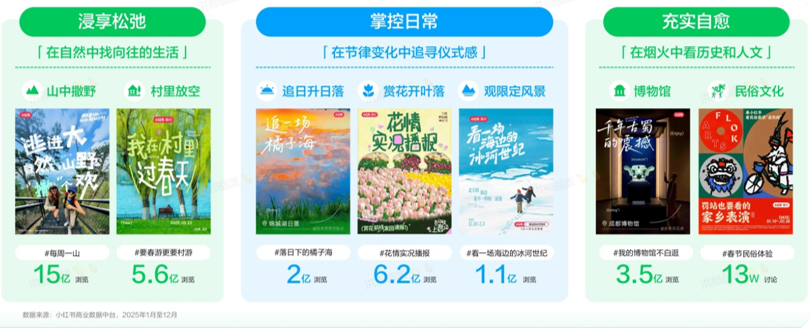
(Screenshot extracted from an industry report)
Relax & Reconnect (Nature-Led Escapes)
- Hiking and mountain retreats: 15+ million engagements
- Rural lifestyle experiences: 6 million engagements
Ritualized Daily Moments (Scenic & Seasonal Immersion)
- Flower-viewing travel: 2 million engagements
- Seasonal landscape exploration: 2+ million engagements
- Limited-time scenic experiences: 1 million engagements
Cultural Fulfillment (Heritage & Humanity)
- Museum-related travel content: 5 million engagements
- Folk culture and traditional experiences: 13 million engagements
2.1 Trend One: The Rise of “Slow Travel”
“Slow travel” is emerging as a defining behavioral shift in China’s tourism market. Experiences such as city walks (Citywalk), boutique homestays, and “hotel-stay vacations” reflect a growing desire to escape fast-paced routines and seek restoration.
Travelers are increasingly prioritizing relaxation, emotional recovery, and unstructured time over intensive sightseeing schedules.
Search volumes for keywords such as:
- “Slow travel”
- “Hotel staycation”
- “Citywalk”
This signals a clear move toward wellness-driven and rhythm-adjusted travel behavior in 2025.
2.2 Trend Two: Immersive “Deep Travel”
“Deep travel” reflects a shift toward immersive, interest-driven exploration. Rather than visiting multiple landmarks, travelers are choosing to center trips around a single theme — such as a music festival, sporting event, or cultural exhibition — and explore a destination more meaningfully.
“Reverse tourism” to smaller cities and lesser-known destinations is also gaining traction, as consumers seek authenticity and localized experiences.
To capture the “deep travel” opportunity, brands should:
- Develop destination-led storytelling
- Design theme-based and interest-focused itineraries
- Offer localized and personalized experiences
As consumer expectations rise, depth and authenticity are becoming key differentiators in China’s travel market.
2.3 Trend Three: Personalized “Private Travel”
“Private travel” reflects a growing desire for autonomy, flexibility, and self-expression. Independent trips and milestone-based travel occasions are increasing, while “photo-worthiness” has become a key decision factor in destination and hotel selection.
Consumers are seeking greater control over travel rhythm and curated experiences that reflect personal identity.
- Social media discussions around “solo travel” continue to rise
- Hotels labeled as “photo-worthy” or “high visual appeal” are gaining traction
- Personalized and niche-interest travel formats are seeing growing demand
These signals suggest that customization and self-expression are becoming central to travel consumption in China. To respond to the rise of private travel, brands should:
- Create visually distinctive and shareable environments
- Design customizable itineraries and flexible product bundles
- Offer themed experiences targeting specific interest communities (e.g., wine enthusiasts, aviation fans, hobby groups)
In 2025, personalization is no longer a premium add-on — it is a baseline expectation.
3.0 WeChat as a Trust & Conversion Hub
Within China’s digital ecosystem, WeChat Official Accounts continue to play a central role in travel content distribution and consumer conversion.
WeChat functions as:
- A one-stop information hubintegrating in-depth content and credibility
- A channel for cultural storytelling and trend amplification
- A bridge connecting online awareness to offline consumption
Travel brands are leveraging WeChat to build authority, trust, and long-term brand equity.
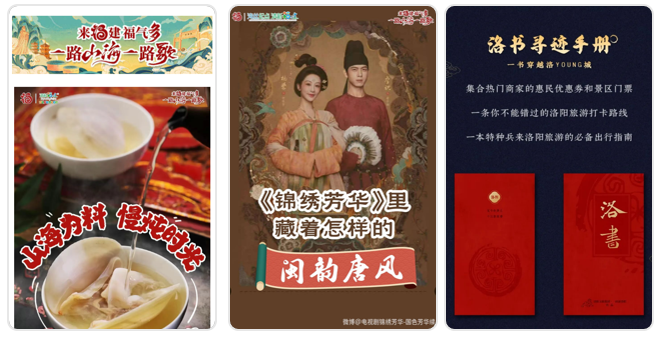
(Screenshot extracted from an industry report)
Three key content directions are emerging:
- Trend-based amplification + cultural depthto drive organic sharing
- Long-form storytelling to strengthen destination perception
- IP collaboration and hot-topic integration to expand reach
This strategy supports both brand visibility and private-domain traffic accumulation.
3.1 Xiaohongshu as the Inspiration Engine
Xiaohongshu (RED) has become a primary platform for travel inspiration and emotional “planting.” It functions as the starting point of travel intent formation, where storytelling and shared experiences shape consumer decisions.
Platform Role in Travel Marketing
- Drives early-stage destination discovery
- Amplifies emotional resonance through user-generated content
- Transforms hotels and destinations into “lifestyle symbols”
Travel consumption on RED is increasingly driven by interest-based discovery, rather than purely geographic selection.
3.2 Weibo as the Amplification Engine
Weibo functions as a real-time amplification platform for brand visibility and public discourse. It is particularly effective for leveraging trending topics, festival marketing, and cross-industry collaborations to generate large-scale exposure.
Platform Role in Travel Marketing
- Amplifies brand campaigns during peak seasons and holidays
- Drives large-scale topic discussions and social engagement
- Strengthens brand positioning through cultural relevance
Holiday-related travel campaigns often achieve heightened visibility through topic seeding and hashtag amplification. In 2025, Weibo remains a key channel for awareness expansion and traffic acquisition. Travel brands should integrate trending topics, cultural moments, and seasonal campaigns to maximize visibility and conversation impact.
3.3 Douyin as the Conversion Accelerator
Douyin has evolved into a dynamic showcase for travel experiences, where content discovery directly connects to transaction growth. Travel-related keywords continue to expand, with stronger integration between cultural tourism and trend-driven content.
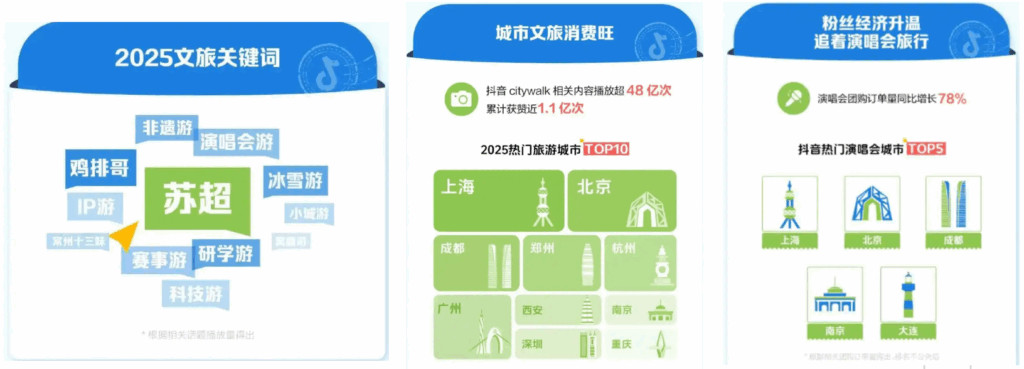
(Screenshot extracted from an industry report)
- “Citywalk” content reached 8 billion views
- Related content accumulated over 110 million interactions
- Concert-related travel orders increased by 78% year-on-year
- Popular concert-travel cities include Shanghai, Beijing, Chengdu, Nanjing, and Dalian
Douyin’s travel ecosystem is increasingly driving real consumption, not just awareness. In 2025, Douyin functions as both a visibility engine and a transaction driver. Brands should leverage trend-based content, experiential storytelling, and live-commerce integration to accelerate booking conversion.
3.4 OTA & Official Stores as Conversion Hubs
OTAs and official brand stores serve as the final transaction touchpoint in the travel journey, completing the pathway from content inspiration to booking conversion. Consumer decisions are increasingly influenced by peer reviews and bundled value offerings.
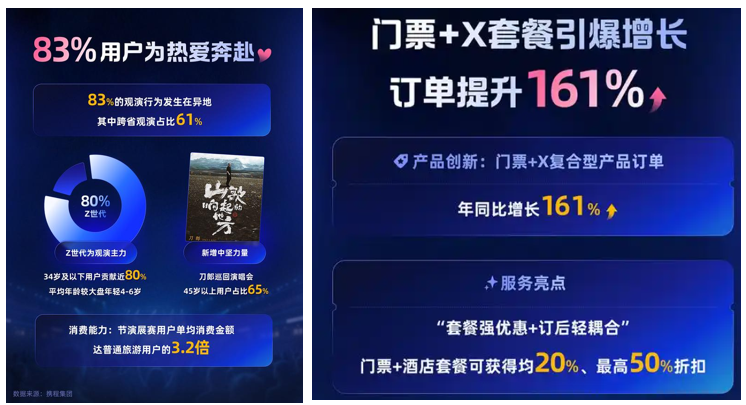
- 83% of usersare influenced by trending seasonal destinations
- Among them, 61% are driven by concert-related travel
- Ticket + bundled package products recorded 161% year-on-year order growth
- Cross-category bundles (ticket + hotel) offered up to 50% discounts
- Gen Z represents over 80% of active travel consumersin certain segments
These figures highlight the growing impact of event-driven travel and experience bundling.
In 2025, OTA platforms are not merely distribution channels — they are product innovation centers. Brands should focus on experience bundling, event-based travel packaging, and value-driven offers to accelerate transaction growth.
(Screenshot extracted from an industry report)
4.0 Social Media Outlook & Strategic Recommendations
As travel consumption shifts from functional demand to emotional value, social media must evolve from a distribution channel into an experience amplifier.
4.1 Strategic Shift: From Information Channel to Experience Preview & Emotional Resonator
As traveler expectations evolve, the role of social media in travel marketing must be fundamentally redefined. It is no longer sufficient to treat platforms as information boards or promotional outlets. Instead, social media should function as:
- An experience preview, showcasing immersive travel moments
- An emotional amplifier, strengthening user connection
- A strategic touchpoint that enhances brand attraction and loyalty
By delivering experience-driven content, brands can establish deeper emotional bonds and increase long-term engagement.
4.2 Building Four Core Content Pillars
Based on the transition from functional consumption to emotional consumption — and aligned with the three major travel trends (Slow Travel, Deep Travel, Private Travel) — brands should construct four structured content pillars.
These pillars should:
- Reflect evolving traveler motivations
- Address segmented audience interests
- Integrate lifestyle storytelling with product design
- Enable precise targeting across social platforms
Through a structured content architecture, travel brands can move beyond isolated campaigns and develop a cohesive, long-term social media ecosystem.
4.3 The Future of Travel Marketing in China
As China’s travel market enters a new phase driven by emotional value, immersive experiences, and platform-native consumption, brands must rethink how they engage travelers across the entire journey — from inspiration to transaction.
Success in 2025 will not be defined by visibility alone, but by the ability to integrate storytelling, experience design, digital ecosystems, and conversion strategy into one cohesive travel marketing framework.
4.4 Ready to Navigate China’s Travel Market?
At OctoPlus Media, we help travel and hospitality brands unlock growth in China through:
- Integrated travel marketing strategy
- Multi-platform social media execution
- KOL & content ecosystem building
- OTA & conversion optimization
- Cross-border market entry solutions
If you’re looking to capture the next wave of China travel demand in 2026, connect with our team to explore how we can tailor a strategic roadmap for your brand.
Feel free to talk to us
It’s a team with one single shared goal, which is our client’s success. Deliver results for your business now.