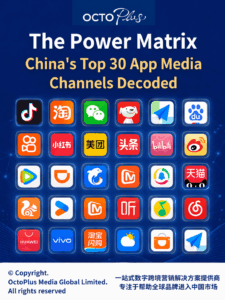



























The Power Matrix: China's Top 30 App Media Channels Decoded
For global Chief Marketing Officers (CMOs) and cross-border business executives looking to scale, the China market represents one of the most lucrative yet digitally complex landscapes in the world. Successfully executing a China digital marketing strategy requires more than just localising existing global campaigns; it demands a fundamental understanding of an ecosystem that operates entirely independently of Western standards. Where international marketing relies on the linear funnels of Google, Meta, or Amazon, marketing in China is driven by highly integrated Super Apps, powerful mobile manufacturer (OEM) networks, and advanced, AI-driven programmatic ecosystems.
To help global decision-makers navigate this unique media landscape, we have analysed the definitive industry benchmark: the QuestMobile 2026 China Internet App Media Advertising Marketing Comprehensive Value – Typical Media Value Analysis Report (compiled from extensive 2025 database tracking). This authoritative whitepaper establishes a quantitative benchmark for China’s top app channels, evaluating them on user traffic, stickiness, target audience quality, monetisation capabilities, and AI integration.
Below, we decode these latest analytical findings to provide global brand leaders with a clear, actionable roadmap to navigate China’s digital landscape and maximise campaign ROI for successful China inbound marketing.
1.0 The Top 30 App Media Channels Ranked by Marketing Value
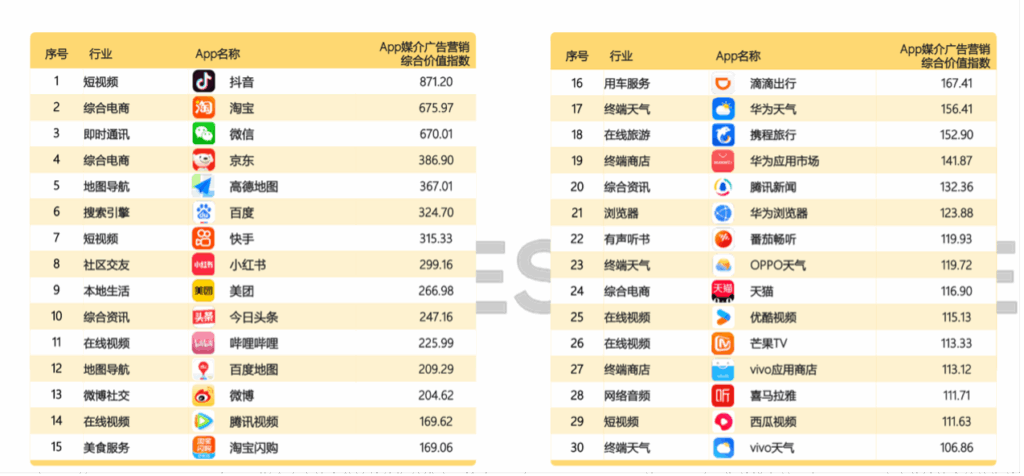
In China, consumer attention is highly concentrated yet heavily tiered. To establish where advertising budgets are most effective, QuestMobile calculated the App Media Advertising Marketing Comprehensive Value Index. This index evaluates platforms based on monthly active users (MAU), daily session stickiness, target audience quality, transactional monetisation, and AI-driven traffic expansion. By analysing the data from the report, we can group China’s top thirty digital media channels (each with over 10 million MAU) into three distinct tiers of marketing value:
Tier 1: The Elite Marketing Giants (Index Score > 600)
These top three platforms form an elite tier of marketing giants, serving as the digital foundation of the China market:
- Douyin (Index: 871.20): Dominating the short-video category, Douyin is the fastest-growing social commerce platform in China. It excels at capturing Gen Z—the cohort representing China’s next powerful group of spenders.
- Taobao (Index: 675.97): The country’s premier general e-commerce destination, Taobao remains unmatched in driving direct, high-volume commercial transactions.
- WeChat (Index: 670.01): The leading super app for messaging, communication, payment, and social sharing, WeChat functions virtually as a mobile operating system.
Tier 2: The Core Growth and Social Discovery Engines (Index Score 200 – 400)
These platforms serve as critical channels for user research, lifestyle trends, and targeted interest campaigns:
- JD.com (Index: 386.90): A general e-commerce giant renowned for its premium consumer electronics and logistics infrastructure.
- Amap / Gaode Maps (Index: 367.01): The leading map and navigation platform, crucial for local life services and location-based targeting.
- Baidu Search (Index: 324.70): China’s primary search engine, essential for traditional search engine marketing (SEM) campaigns.
- Kuaishou (Index: 315.33): A short-video powerhouse with deep penetration in China’s rapidly growing lower-tier cities.
- Xiaohongshu (Rednote) (Index: 299.16): The premier community and social commerce destination, serving as China’s primary hub for word-of-mouth (WOM) discovery and premium product research.
- Meituan (Index: 266.98): The dominant platform for local lifestyle services, food delivery, and on-demand retail.
- Toutiao (Index: 247.16): The leading general news and information aggregator powered by smart feed algorithms.
- Bilibili (Index: 225.99): An online video and anime, comic, and games (ACG) community, ideal for targeting younger consumer demographics.
- Baidu Maps (Index: 209.29): A core map and navigation service providing valuable offline-to-online marketing touchpoints.
- Weibo (Index: 204.62): One of the most popular social media networks, which layers precise data targeting with device ID matching to connect with audiences via high-quality native ads.
Tier 3: Specialized Platforms and OEM Terminal Ecosystems (Index Score 100 – 200)
This tier highlights the massive, unique power of hardware brand services and online travel agencies in China:
- Tencent Video (Index: 169.62): A leading online video platform for long-form dramas and variety shows.
- Taobao Flash Buying / Taobao Shangou (Index: 169.06): A specialized food and delivery service nested under the Alibaba ecosystem.
- Didi Chuxing (Index: 167.41): The dominant ride-hailing and smart mobility network in China.
- Huawei Weather (Index: 156.41): A native terminal utility app representing system-level user reach.
- Ctrip / Trip.com (Index: 152.90): The primary online travel agency (OTA), essential for capturing Chinese outbound tourists.
- Huawei AppGallery (Index: 141.87): The native terminal app store for Huawei devices, acting as a crucial app distribution channel.
- Tencent News (Index: 132.36): A high-traffic general news platform under the Tencent ecosystem.
- Huawei Browser (Index: 123.88): The native terminal web browser pre-installed on hundreds of millions of devices.
- Tomato Free Audiobooks / Fanqie (Index: 119.93): A fast-growing network audio and reading platform.
- OPPO Weather (Index: 119.72): A native terminal utility representing OPPO’s hardware-level marketing footprint.
- Tmall (Index: 116.90): Alibaba’s premium e-commerce platform specifically designed for official brand flagship stores.
- Youku (Index: 115.13): A veteran online video platform owned by Alibaba.
- Mango TV (Index: 113.33): A highly popular online video network famed for its original entertainment content.
- vivo App Store (Index: 113.12): The native terminal app store for vivo device owners.
- Ximalaya (Index: 111.71): China’s leading network audio and podcast platform.
- Xigua Video (Index: 111.63): A mid-to-long form short-video distribution channel.
- vivo Weather (Index: 106.86): A native terminal utility app for vivo system-level ad placements.
2.0 Core Platform Deep Dives: WeChat, Douyin, and Xiaohongshu (Rednote)
To successfully establish a digital presence during your China market entry, global businesses must look past top-line traffic statistics and understand how these platforms integrate into a consumer’s daily life.
2.1 WeChat: The Foundational Infrastructure
WeChat is the digital glue of China. Evaluated with a marketing index of 670.01, it is an all-in-one ecosystem combining messaging, social sharing, payment, brand hubbing, and native lightweight applications.
For Western executives, think of WeChat not as a messaging app like WhatsApp, but as an entire mobile operating system. A brand’s WeChat strategy operates through four tightly integrated components:
- WeChat Official Accounts: These serve as the verified brand and content hubs where companies publish official announcements and localised copy to build brand equity.
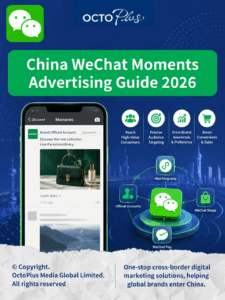
- WeChat Moments: Brands can leverage targeted banner and feed advertisements on Moments to maintain consistent market exposure using precise geographical and interest targeting.
- WeChat Mini Programs: These are native, lightweight applications that run directly inside WeChat. They bypass modern web browsers, providing customised cross-border e-commerce storefronts, immersive AR/VR shopping experiences, and seamless payment processing.
- WeChat sCRM & Payment Integration: By connecting native WeChat stores with WeChat Pay and social Customer Relationship Management (sCRM) systems like WeCom, brands can manage a customer’s entire buying cycle and retention funnel without the user ever leaving WeChat.
2.2 Douyin: Capture Gen Z with Social Commerce
With a dominant ranking score of 871.20, Douyin is the ultimate short-form video and entertainment ecosystem. It is particularly effective at capturing Gen Z—the cohort representing China’s next wave of high-spending consumers.
Unlike Western short-video platforms where e-commerce is largely outsourced to third-party links, Douyin is a fully integrated search, entertainment, and shopping destination. Douyin features a complete service matrix, including official brand account management, tailored target-marketing paid ads, native video ad buying, and specialised influencer (KOL/KOC) campaigns to drive immediate social commerce conversions.
2.3 Xiaohongshu (Rednote): The Content SEO Powerhouse
Ranked 8th with an index of 299.16, Xiaohongshu (Rednote) is China’s premier lifestyle-sharing and word-of-mouth community. It serves as a visual search engine where hundreds of millions of highly educated, urban, and affluent Chinese consumers research premium goods, cosmetics, education, and global travel.
For global brands, traditional Google-style search engine optimisation is ineffective in China. Instead, you must implement Xiaohongshu (Rednote) Content SEO (CSEO). CSEO focuses on ranking your brand’s native posts and key influencer reviews (KOL/KOC content) within Xiaohongshu (Rednote)’s internal search results. By optimising for specific keywords, your brand’s content can appear at the top of search results, guaranteeing organic search traffic and creating a highly credible digital footprint.
3.0 The OEM Terminal Ecosystem: Hardware-Level User Reach
One of the most profound differences in China digital marketing is the sheer power of mobile manufacturer (OEM) ecosystems, with Huawei leading the way. Rather than relying solely on third-party apps, device manufacturers retain direct user relationships by integrating programmatic touchpoints directly into the device’s operating system.
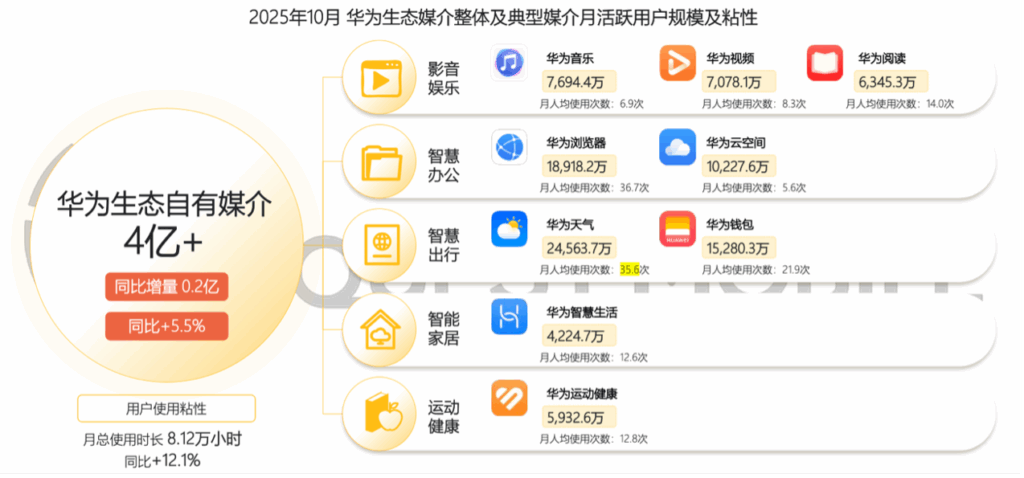
According to QuestMobile report, the Huawei ecosystem boasts massive monthly active users across its native utility and service apps:
- Huawei Weather: 245.6 million MAU (with users opening the app an average of 35.6 times per month)
- Huawei Browser: 189.2 million MAU (with users opening the app an average of 36.7 times per month)
- Huawei Wallet: 152.8 million MAU (with users opening the app an average of 21.9 times per month)
- Huawei Cloud Space: 102.3 million MAU (with users opening the app an average of 5.6 times per month)
- Huawei Music: 76.9 million MAU (with users opening the app an average of 6.9 times per month)
- Huawei Video: 70.8 million MAU (with users opening the app an average of 8.3 times per month)
- Huawei Reading: 63.5 million MAU (with users opening the app an average of 14.0 times per month)
- Huawei Sports & Health: 59.3 million MAU (with users opening the app an average of 12.8 times per month)
3.1 The “Huawei Full Family Set” Consumer Trend
The QuestMobile report highlights a strong consumer affinity for hardware ecosystem integration, referred to in Chinese social spheres as the “Huawei Full Family Set”. On Xiaohongshu (Rednote), community posts discussing the seamless interaction between Huawei phones, tablets, laptops, and smart vehicles reached 2,188 native posts and generated over 175,000 interactions in Q3 alone. Notably, 65.1% of these posts were organic, user-generated content from everyday consumers praising features like HarmonyOS multi-device file sharing and automated smart travel setups.
For global marketers, this hardware-level ecosystem means your programmatic campaigns can target consumers across their entire daily device journey. OEM systems bypass third-party apps by delivering system-level widgets, targeted lockscreen imagery (open-screen ads), browser launch placements, and intelligent voice assistant suggestions directly to the device owner.
4.0 The Intelligent Upgrade: From Data Tools to Marketing Brains
The QuestMobile report details how China’s programmatic buying platforms are rapidly evolving through AI and advanced data science. Leading networks are moving beyond basic demographic targets to construct highly detailed user profiles.
As mobile ecosystems shift from single-point touchpoints to cross-scenario intelligent services, native system-level AI assistants like Xiaoyi Agent have emerged as vital marketing channels. Backed by robust security, Xiaoyi boasts over 150 million monthly active users, offering high-frequency touchpoints and stable scenario penetration.
By utilising system-level assistants and intelligent programmatic networks (such as Huawei’s Whale Dynamic suite), global brands can achieve precise targeting and seamless ad delivery:
- Whale Index: An analytical metric used to quantify user demand, interest, and emotional consideration scores across different industries, brands, and campaigns.
- Whale Mansion: A data platform that integrates offline location-based services (LBS) with online behaviour to build a virtual “digital twin” of target consumer segments, tracking their digital life trajectories and purchasing cues.
- Petal Agent: An end-to-end, automated AI engine that handles audience discovery, creative asset adaptation, smart budget bidding, and real-time campaign reporting.
This native intelligence ecosystem allows brands to deliver context-aware, highly targeted services—such as transport booking recommendations and route-appropriate, local brand suggestions—directly to the consumer’s device screen exactly when they need them.
5.0 Navigating Your Entry into the Chinese Digital Ecosystem
Entering China’s digital space requires more than just translating campaigns; it demands an experienced, localized partner who can manage these unique programmatic and social ecosystems. As an integrated digital marketing agency focused on China inbound and outbound marketing, OctoPlus Media specialises in turning these complex local channels into highly profitable growth engines.
Through our proprietary data solutions—including China Data Bank™—we enable international brands to identify, target, and convert high-value Chinese consumer segments with incredible precision. As a pioneer and comprehensive WeChat ecosystem service provider, we offer complete one-stop solutions ranging from official account registration and localization copywriting to custom WeChat Mini Program development, cross-border e-commerce setups (via our WeSales platform), and advanced social CRM integration.
Furthermore, our dedicated local teams coordinate high-impact campaigns on Xiaohongshu (Rednote), executing targeted influencer (KOL/KOC) marketing, paid media buying, and professional Xiaohongshu (Rednote) Content SEO (CSEO) strategies to put your brand on the first page of search results. Partner with OctoPlus Media to navigate China’s digital frontiers and unlock your brand’s true potential in the world’s most dynamic market.
Feel free to talk to us
It’s a team with one single shared goal, which is our client’s success. Deliver results for your business now.