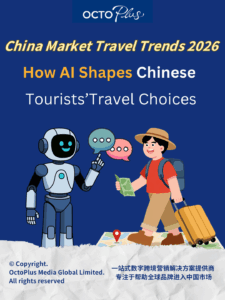




























China Market Travel Trends 2026: How AI Is Changing How Chinese Tourists Discover and Choose Destinations
In 2026, AI travel in the China market has officially evolved from a supporting tool into a full-service assistant.
The starting point of travel decision-making is shifting from choosing destinations to understanding traveler needs first.
AI is now the key factor balancing cost-efficiency and experience, reshaping how Chinese tourists plan trips, discover destinations, and make travel decisions.
1.0 AI Is Fully Adopted: Travel Planning Behavior in China Has Reversed
AI travel has already reached large-scale adoption in the China market tourism ecosystem.
For example, AI-powered travel assistants have:
- generated over 1.31 million travel itineraries
- covered 55 countries and 416 cities
- saved users over 4.7 million hours in travel planning
The most important shift is in Chinese travel planning behavior:
Instead of “Where should I go?”, users now start with “What kind of trip suits me best?”This means: AI is now the decision-making entry point and travel planning is user-centric, not destination-centric
At the same time, niche travel destinations are rising. Demand for family travel, solo trips, and “relaxed” itineraries is increasing. 77% of travel still happens domestically, but expectations are shaped by personalized experiences
For overseas tourism businesses, this means: you are no longer competing by location but by relevance.
2.0 Who Are Chinese Travelers Today?
AI travel is no longer limited to younger users—it reflects a broad and practical audience.
Key characteristics of Chinese tourists travel trends:
- 80s & 90s generation account for 73% (core market)
- 70s and older users make up 26% (growing adoption)
- Over 70% come from emerging cities (lower-tier markets)
- Travel types with highest AI usage:
- Solo travel (42%)
- Family trips (27%)
Budget and behavior:
- 80% spend under RMB 6,000
- Prefer 3–5 day trips
- Focus on value-for-money and experience fit
This reflects a key shift in the China travel market: Practical, value-driven, and experience-oriented decision making
3.0 From Travel Guides to Full Journey Automation
Traditional travel planning required users to:
- search across platforms
- compare information manually
- build itineraries step-by-step
Now, AI enables one-click travel itinerary generation that’s covering:
- pre-trip planning
- in-trip assistance
- post-trip content creation
At the same time, AI connects directly with the tourism supply chain:
- real-time product matching
- dynamic pricing and availability
- faster response to niche demand
This creates a new model of instant matching between demand and supply.For businesses entering the China market tourism sector, this means your product must be AI-readable and structured and your offering must match specific use cases, not generic audiences
4.0 AI Is Becoming the Main Traffic Entry Point
AI is no longer just a tool, it is becoming the primary gateway to travel discovery in China. Instead of browsing multiple OTAs and comparing blog content, users now rely on AI-generated answers and recommendations.
This shift is redefining:
- China travel platform trends
- how destinations are discovered
- how travel decisions are made
At the same time, AI delivers two-way value:
- For travelers → better, faster, more personalized experiences
- For businesses → data-driven insights for:
- product design
- pricing strategy
- operational optimization
5.0 Future Outlook: 10 AI Travel Trends Shaping the China Market
Looking ahead, AI will become a standard across the travel industry. Key AI travel trends in China include:
- Rise of niche travel destinations
- AI as a “travel companion” throughout the journey
- Automatic travel content and memory generation
- Adoption of physical AI (robots, drones) in tourism
- AI-powered cultural and creative customization
- Smart scenic spots with AI-driven experiences
- Flexible supply chains with real-time matching
- AI as the core travel traffic入口
- AI travel assistants becoming industry standard
- Deep integration between tourism and other industries
6.0 What This Means for Overseas Tourism Businesses
For brands looking at how to attract Chinese tourists, the rules are changing. Success in the China market tourism landscape will depend on:
- Understanding AI-driven travel behavior
- Positioning your destination within specific user needs and scenarios
- Adapting to AI-powered discovery and recommendation systems
How OctoPlus Media Helps You Grow in the China Market
As AI reshapes how Chinese tourists discover and choose destinations, success in the China market is no longer just about visibility—it’s about being relevant across the entire travel journey.
At OctoPlus Media, we support overseas tourism brands with a full-service marketing approach, helping you navigate the China market and connect with the right audience.
We help you:
- Build clear positioning based on Chinese travel behavior
• Create localized content that matches user intent and search patterns
• Increase visibility across key China digital platforms
• Develop full-funnel strategies to attract and convert Chinese tourists
• Use data-driven insights to continuously optimize performance
In today’s China market tourism landscape, success comes from combining strategy, content, and execution to reach travelers at the right moment.
Feel free to talk to us
It’s a team with one single shared goal, which is our client’s success. Deliver results for your business now.